

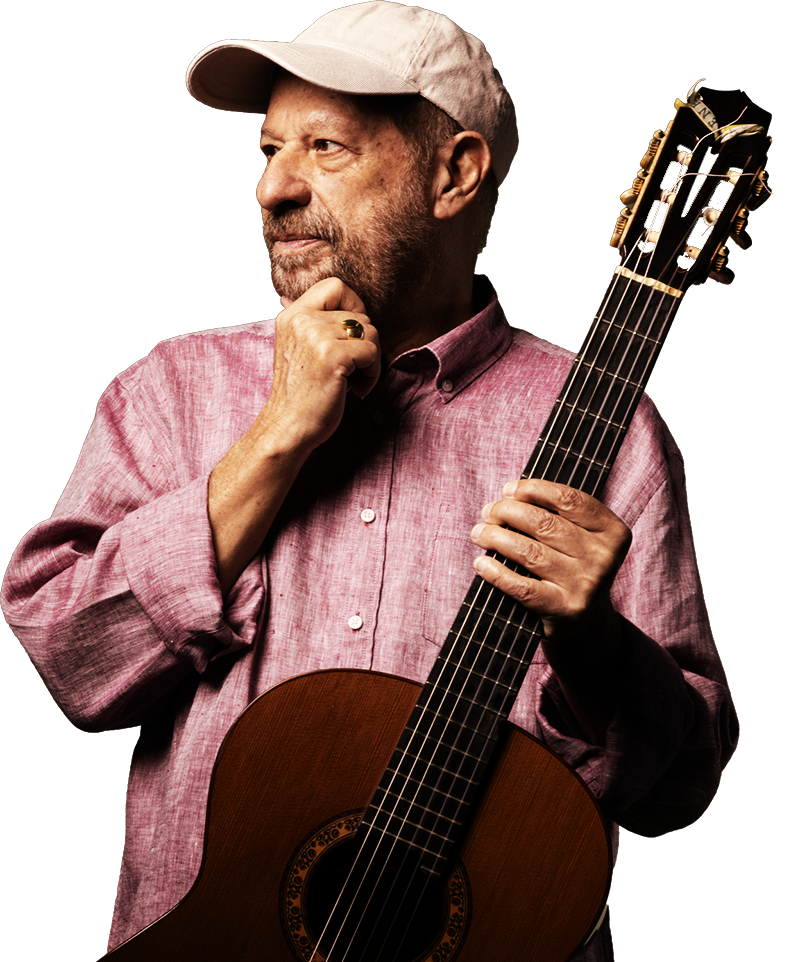
Release Não vou pro céu - Eucanaã Ferraz (english)
The new work by João Bosco makes the recent debate about the death of melody looks hopelessly outdated, as a discussion that served as increment to Brazilian music reviews, but which no longer serves as a pattern to think the future.
It‘s the album of a great singer, with total mastery of the technique, well-dosed emotion, a bright tone of voice, yet harsh and sharp in its docility whose softness is just one of its experiments. It‘s the album of a great musician, himself symbolizing a school of Brazilian guitar, similar to, in their own way, João Gilberto, Baden Powell and Gilberto Gil. It‘s the album of a great composer, who owns a unique language in which melodic and harmonic inventions sound simultaneously spontaneous and extremely elegant.
Summing up the three resulted in his own story within the large scope of Brazilian music which gains now, with Não vou pro céu mas já não vivo no chão (Not heading to heaven but no longer living on the ground), an stimulating increment.
One of the songwriting partnerships with Aldir Blanc, ?Navalha?, is worth all possible celebration for the duo long-awaited comeback. Love theme flows into the image of a crucified Christ, referring to physical and spiritual suffering, to drama and desire laceration, which have distinctively characterized the baroque imaginary. Therefore, the
?passion‘ of Christ also refers to the passion of men, enclosing within one word-nail human and divine, pain and pleasure, light and darkness, life and death.
It‘s not by chance that one of the partnerships with Francisco Bosco has a first person view of a ?Baroque Soul?.
Baroque and from Minas Gerais, we might add. Moreover, it‘s essential to notice how much João Bosco‘s baroque aesthetic , in this new album, arises just like the baroque of the churches from Minas Gerais – less elaborate, severe, subtle in its bright-dark games, hence more classic. Tortuous lines, tension between masses and volumes, dramas of light and shadow and the formal cult emerge, then, under the control of an economics focused on the least.
And so, still on the track ?Navalha?, the voice, the guitar of João Bosco and the countermelody of Ricardo Silveira‘s guitar, create an atmosphere of controlled tensions yet mystic, full of suggestions.
Such baroque slightly erotic, melancholic, nostalgic and, at the same time, intense and deadly as a blade could still be felt in other images, as ?the church ceiling‘ in the very gentle opening track, ?Perfeição?, or in the drive towards death – better yet, towards elevation, through fading in emptiness – of the moving ?Desnortes?, in which the Christ once again, emerges – in Rio de Janeiro‘s landscape – ?levitating/against the sky?, and the shattered duality in statements like ?I‘m attracted by infinite? and ?all is feverish, all wishes to be, all pulses?. Lyrics of ?Alma barroca? states:
?My foot is on the ground/ my heart in the air?. The track ?Plural singular? talks about
?not-being becoming being?. And the album title, taken from ?Sonho de caramujo?, works almost like a catch phrase, declaration of aesthetics and existential principles: “Não vou pro céu mas já não vivo no chão?. Even landscape is portrayed in paradox key: ?the sun/ ocean lights up, silver, almost glacial?. It‘s in contradiction and paradox
attractions that carefully move the constitutive elements of this album. Its baroque soul is found there and not in the adornment.
All of this is just one of the many possible ways to get closer to the complexity and beauty of Não vou pro céu mas já não vivo no chão. Closeness that demands extreme ears and attention, as we face vibration, pain, emotion, joy, in short, a series of affections, but also of the absolute virtuosity, in a set where everything is mathematically precise, in which breathing mingles with the voice, voice with the skin, body with the instrument, meaning with the sound. And if it sounds contradictory that emotional vigor is contained in rigor, in the economics of the least, the ears easily recognize an exceptional unity which tends to concision. That‘s what sounds absolute in every single track.
Singing does not miss a fraction of the syllables. Therefore, the songs intensively shine as a speech; beyond, the lyrics architectonically materialize themselves and their meaning emerge in absolute balance with the music.
Everything sounds as sharp as a razor. That could be easily the album‘s title:
?Navalha/Razor?. Because everything within it is like a blade, sharp – the songs, the strings, the singing, the arrangements. Similar to the renowned image by João Cabral de Melo Neto, we‘ve got ?a knife all blade?: no choice of getting near without getting hurt, no safe area, no tiniest spot outside intensity and beauty.
Just listen to ?Tanto faz?, partnership with his son, Francisco Bosco. The elegance in the singing, precise, straight, sounds like a statement of a life in which no illusion could fit anymore. An outflow, that would definitely sound mellow, if it wasn‘t for its extreme skeptical force, its sense of freedom: ?I will leave/ Just as I‘ve come / Asking nothing / From nobody?. But, once again, contradiction brings its shine of dagger when, at the end, sharply vocalizes it – whining, crying, almost a shout – almost denying the words that spoke only of certainty, reason and stolid aesthetic. Explosion and contention, therefore, mix into a musical dynamic where always reminds us of great classics of original sambas from Rio de Janeiro. But ?Tanto faz? is more than an allusion or tribute, we might even say that it‘s already a classic.
There are, in many moments of the album, a kind of historical vein supporting the songs, which is, at the same time, supported by them. I refer, for instance, to the history of samba – from the 30‘s to João Gilberto – which seems to emerge in the harmonies of
?Navalha?.
Similarly, ?Pronto pra próxima?, a gifted partnership with Carlos Rennó, appears as a subtle tribute to Orlando Silva, Gershwin and Tom Jobim. The same way, another partnership with Rennó, ?Pintura?, presents the delicacy and rhythm that reminds Caetano and João Donato.
?Desnortes? is a typical beach song from Rio de Janeiro, modern, with hints of Chico Buarque and Antonio Cicero, making a touching return to the serenades, at same time mentioning Caymmi in one of the most beautiful moments of the album. ?Mentiras de verdade?, by Bosco-Blanc, is in its turn, a samba-canção of traditional cut which seems to point at Tito Madi and his sambas of modern harmonization that deeply influenced bossa nova. Aldir Blanc‘s lyrics present the dense elegance and melancholic
disillusion of ?Chove lá fora? or ?Cansei de ilusões?. But the setting wouldn‘t be complete without the bass of Jorge Helder, the guitar of Ricardo Silveira, the drums of Jurim Moreira and the guitar of João Bosco.
More explicit quotation, maybe, is ?Jimbo no jazz?, outstanding partnership with Ney Lopes. The tribute to Ray Charles is recalled in the vocals that open the song, and also in the rhythmic guitar and the jazzy harmony. If the reference seems unexpected, it‘s mandatory to listen to, among others, ?Bate um balaio or Rockson do Pandeiro?, by Gagabirô (1984) or Cabeça de nego (1986). The latter, no doubt, is one of the most experimental albums of Brazilian music in which emerges an invented Africa through a collage of funk, samba, jazz, blue, umbanda, choro and rock and roll, with special references to Bill Haley and his ?Rock around the clock?. Here, in ?Jimbo no jazz?, Ray Charles‘ classics resonate, such as ?I got a woman?, ?Don‘t set me free? or ?What‘d I say?. The lesson – the same lesson as Cabeça de nego‘s songs – is even more clear in the tribute: ?the jazz the samba and the milonga and the tango and candombe/ And the rumba and the mambo, they all come from Congo?. The greatest tribute is paid, in this declaration of black music universality, translated, let‘s say, in the own percussive lyrics of this song which is basically a tongue twister, full of humor and swing: ?entao, o samango, mondrongo, mubungo, piongo/ largou da rezinga e caiu no fandango”. In the little tale narrated in the song, the character who synthesizes everything could only be a musician, Jimbo, the trumpet player who is in charge of showing with his own music that jongo is jazz, better yet, that everything is Africa.
Thou, the African presence is more remarkable in the delicious ?Tanajura?, for its rhythm, but also for the afro guitar, short, dancing by João and Ricardo Silveira in a happy association with a subtle but expressive percussion by Robertinho Silva and Armando Marçal.
The jazzy conversation proceeds in the ballad ?Plural singular?, intimate, coltraneish, when, once again, the quartet assembled by Jurim Moreira, Jorge Helder, Ricardo Silveira and João Bosco reach a sophisticated and warm sonority, with emphasis to a delightful jazzy jam.
The lovely samba by Serafim Adriano, ?Ingenuidade?, could be seen as a subtle tribute to Clementina de Jesus, absolute reference to João Bosco, once the song was recorded by her in the album Clementina de Jesus (1976), featuring Carlos Cachaça and where she also sings ?Incompatibilidade de gênios?, by Bosco and Blanc. In the recording of Não vou pro céu… singing and guitar, clearly, underline lyricism, smooth colors and sophisticated simplicity of Serafim Adriano‘s samba (an opposing reading from Caetano‘s Zie e Zii, so cerebral and yet so sinuous and rugged). The simplicity of
?Ingenuidade? has its immediate counterpoint in ?Alma barroca?, crafted, dense, prickly, with voice and guitar as excited as well designed in ascending curves.
Closing the album, ?Sonho de caramujo?, partnership with Aldir Blanc, works as a kind of profession of faith – a rite which clearly signalizes guidance, testifying a desire and a commitment. The shortness of lyrics goes against what is expected from a samba- enredo format, as well as the affirmation of an intimacy, almost closeness – ?I live inside the shell of my guitar? –, denies the collective tendency of the genre. The singing extroversion, in a very high register, seems to take to a paroxysm the interpretation of samba school singers while the choice of accompaniment – just two
guitars – once again breaks the expectation of the obvious presence of a percussion, here reduced to a few bangs on the guitar wood, gesture with which the ? snail‘ musician ensures the value and the totality of his home-shell. But if lyrics, inverting the signals of traditional samba-enredo, narrates a personal story, in first person, there is, however, the exotic landscape, to please carnival makers: ?…riding an elephant in Bombay?. Invented landscape, fruit of imagination, we may then say, that this samba is a homage to the book and to reading, that dialogues in popular register with Castro Alves‘ classic,
?O livro e a América? (?Holy is the one who sows / Books…a handful of books…/ And order people to think!/ The book falling upon the soul/ It‘s germ — that makes the palm,/ It‘s rain – that fills the ocean (…)?. Books and guitars are similar; they‘re essential shelters, intestines, yes, but providing fantasy and enlarging horizons of time and space.
Hence, in João Bosco‘s guitar shell it seems to echo the history of samba, of the Brazilian music, of the black music from the US, from the Caribbean, anonym music from ancient Gerais and the City of Salvador, as well as the Beatles and, at last, the whole musical work of Bosco himself along with his partners, highlight given, no doubt, to this magnificent Aldir Blanc and the assurance of a new great lyricist, Francisco Bosco. Everything gets bent and confused into a spiral – once again, the baroque – with twists and turns where shadow and light give body and soul to songs reaffirming life and driving death very far away.
Eucanaã Ferraz
Entre memórias, caminhos e canções, sigo sendo aquilo que o tempo e o coração inventam.
Entre memórias, caminhos e canções, sigo sendo aquilo que o tempo e o coração inventam.